As 2019 comes to a close, our researchers share highlights from the year and new directions for 2020.
Data released in 2019 showed good news: opioid overdose deaths declined in 2018. But the numbers (47,608 opioid overdose deaths and 68,588 total drug overdose deaths) are still too high. We have been studying the opioid epidemic on the ground in local communities for the past two years. Understanding the root cause of the problem is essential for putting in place policy solutions that will work.
In 2019, we spoke before communities from Saratoga to the Bronx and to policymakers from Albany to DC. We tell them that the media narrative of “deaths of despair” just doesn’t hold true. Instead, the data (mapped here) suggest physician prescribing patterns and (in)access to treatment better account for why this problem hit white, rural communities especially hard. And our experience in local communities shows how they are fighting back. In June, we held a photography exhibition and panel discussion to highlight several innovative grassroots responses.
In 2020, we will expand the focus of our project with a deeper dive into urban communities and to state and federal policies.
For more on what the problem looks like on the ground and what policies might alleviate it, see the Stories from Sullivan page.
The Rockefeller Institute added a new dimension to its work on student loan debt in New York in 2019, enlisting five undergraduates from our Center for Law and Policy Solutions internship program to evaluate the human side of the problem. The team gathered first-hand information from current students about their perspectives on incurring debt and about their financial preparation for college. Leading the team, the Rockefeller Institute’s Dr. Katie Zuber noted that this group of interns broke new ground for the program in many ways: it was the first partnership of students from the University at Albany and Hudson Valley Community College; it was the first research project to use focus groups; and it was the first project that required students to seek approval from the Institutional Review Board.
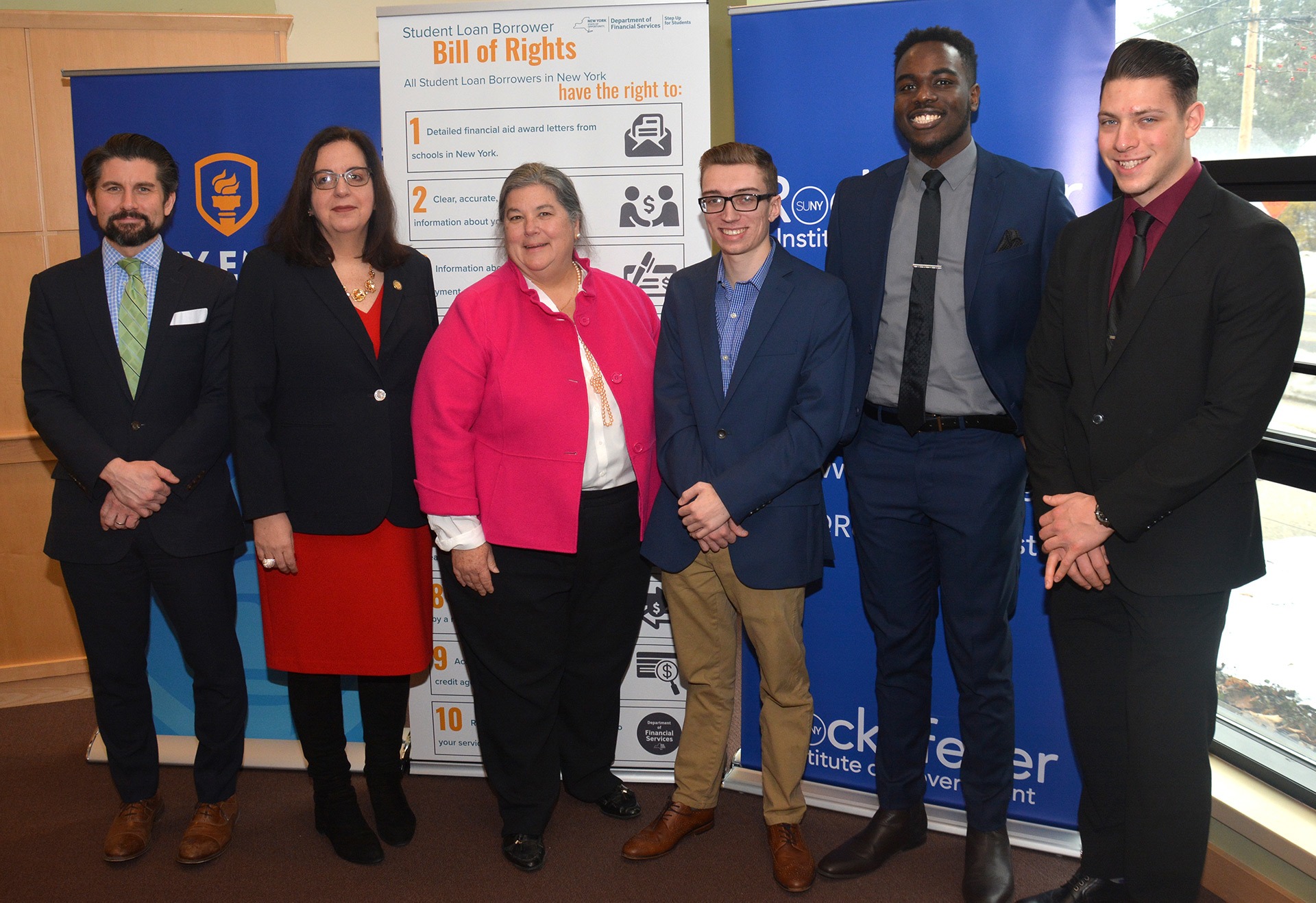
The CLPS interns found the burden of becoming financially literate is too great for many students and it is better to have public policies that actively deliver needed information rather than passively making such information available. One-on-one information sessions are better than simply handing students pamphlets and referring them to websites. So, too, direct outreach into the schools, homes, and communities of future borrowers is necessary. Following a student loan debt discussion panel moderated by Director of Education Policy Studies Brian Backstrom, the intern team interviewed officials from the New York City Department of Consumer Affairs’ Office of Financial Empowerment and recommended that the state look closely at replicating its neighborhood outreach programs.
By year’s end, the New York State Department of Financial Services (DFS) announced a new Student Borrowers Bill of Rights, and the Rockefeller Institute announced the formation of a partnership with SUNY’s Empire State College and DFS to create an internship in 2020 for undergraduate students to work directly with DFS on student loan debt issues.
 The Rockefeller Institute of Government’s Center for Law and Policy Solutions (CLPS) informs public policy development through evidence-based practice and research. 2019 marked a year of expansion as we welcomed new members from Empire State College to help guide the Center’s work. Notably, Dr. Rhianna Rogers, associate professor at SUNY Empire State College, was named the inaugural Ernest Boyer Presidential Fellow and will lead the CLPS internship program in Spring 2020.
The Center’s internship program continues to provide undergraduate students with meaningful opportunities to conduct applied policy research. For the first time, the Center welcomed students from Hudson Valley Community College (HVCC) to join their counterparts from the University at Albany to study the important issue of student debt. By conducting focus groups on three college campuses in the Capital Region, CLPS interns helped center students’ voices in the national conversation about student debt. Their research suggests that while many students view college as a critical investment in their future, fewer feel prepared to make important financial decisions about how to pay for college. In 2020, students will take an interdisciplinary look at the broader theme of “Building Community in Times of Social Unrest,” developing a deliberative conversation designed to encourage cross-cultural dialogue as the 2020 presidential election fast approaches.
Policy Outsider, the Rockefeller Institute’s podcast, completed its successful first, full calendar year in 2019. The podcast examines pressing public policy issues facing New York State and the nation to inform listeners about how decisions of law and policy affect our daily lives. Over the past year, Policy Outsider covered many issue-areas, including student loan debt, effective gun homicide reduction policies, marijuana and federalism, and a visit to Sullivan County to talk with people who are in recovery. Other conversations featured the role of Artificial Intelligence will have on New York’s labor force, why village residents often object to village dissolution, and the challenges of researching an issue in real-time, such as vaping.
Policy Outsider broadens the way people can discover relevant and timely research, and, by packaging the Institute’s work across multiple platforms, we are more accessible and can deliver cutting-edge research to a broader audience. The podcast also directly connects the audience with the Institute’s team of researchers, gaining insight into the methods behind the research to learn why what we do is valuable to both the public and to policymakers.
For 2020, we will continue to provide what the audience expects of us: innovative research and lively conversations that help explain the importance of public policy. Our creative team is finding new ways to integrate more of the Institute’s work into the podcast. In a recent episode, “Detecting Dyslexia,” research experts from across the nation discussed key findings from an Institute-hosted forum. As public policy continues to play an outsized role in our daily lives, the ability to find — and understand — the issues at hand play an integral role for informed decision making.
In 2019, the Rockefeller Institute of Government’s Center for Law & Policy Solutions examined the opportunities and challenges of higher education programs that serve incarcerated students within New York’s state correctional facilities, bringing the latest evidence and developments in the field over the last twenty-five years into focus and providing a crucial guide to policymakers and the public on a promising policy area.
Under the guidance of Center Director Dr. Katie Zuber, a team of undergraduate research interns — Trevor Craft, Nicholas Gonzalez, Kevin Kelleher, Miki Rose, and Ofu Takor — blended what we know from existing research and new insights gained through interviews with senior policy experts and practitioners. The team produced recommendations on implementing college-in-prison programs, including how to improve the quality of existing programs and expand educational opportunities throughout New York. Their findings affirmed that well-positioned programs can effectively reduce recidivism, increase employment, and provide broader community benefits. Against the backdrop of federal and state efforts to expand post-secondary education programs, the students presented their research in a public forum at the Institute in June 2019, which was attended by senior government officials, and published in a widely-shared report, “A Second Chance: College-in-Prison Programs in New York State.”
In 2020, the Institute will monitor the development, deliberation, and implementation of federal and state proposals to increase access to education for incarcerated students.
Health was a big issue in 2019, and it’s likely to continue to be one again in 2020. We had two events at the Rockefeller Institute to address it.
Because America’s healthcare system is both uneven and expensive, presidential candidates, in particular, have been talking about reform. What would these reforms look like and what impact would they have on existing healthcare provision? In a forum we held at the Rockefeller Institute, we broke down what different healthcare reform options look like and what implications these reforms may have. We summarized our findings here.
We also brought in experts to talk about how to improve population health, more generally, in New York State. Social and economic inequalities lead to health disparities across different populations. Because of its program design, Medicaid has been a flexible option to address the social and economic factors that affect health. Medicaid, however, cannot do it on its own. For more on efforts to address population health in New York, see our summary.
Health and healthcare will be big issues again in 2020, especially for states and localities. We’ll be watching how states navigate the high costs and complexities of healthcare systems in the new year.
The Rockefeller Institute explored how emerging technologies such as artificial intelligence (AI) and automation will impact the nature of work for New York’s labor force in its series AI:NY. The series explored how New York Power Authority line workers are integrating drones into their work; identified occupations currently working to develop AI technologies and how New York can bring its leadership in innovation to foster NY’s AI workforce; and reviewed predictions made at the beginning of the digital revolution to better understand how employment can be impacted by the next wave of technologies.
AI is just one of the technologies shifting the nature of work. In recent years we have seen automation of service jobs, the development of the gig economy, and the expansion of self-employment. These shifts will change how workers are trained, where they choose to live, and how they engage with employers. Policymakers in NY and globally are working to identify the best policies that will support residents and attract employers in this changing labor market.
In 2020, Rockefeller will launch the Future of Labor Center. In collaboration with SUNY Empire State College’s Harry Van Arsdale Jr. School of Labor Studies, Institute researchers will examine the changing nature of work, and the implications for workers, employers, and worker organizations. In the coming year, the Center will a host a forum on the Future of Work and name the first recipient of the Morton Bahr Research Fellowship.
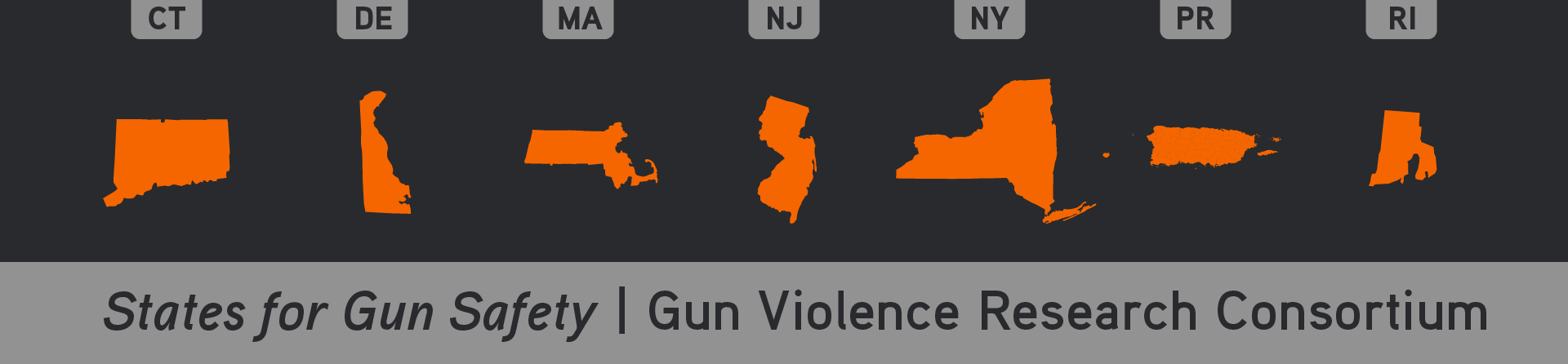
Gun violence continues to devastate communities across the United States with firearm-involved deaths reaching a forty-year high of nearly forty thousand people, according to the most recent national data. In 2019, the Regional Gun Violence Research Consortium – coordinated by the Rockefeller Institute of Government as a part of the States for Gun Safety Coalition – brought the latest research on firearm-involved violence and analysis of policy recommendations to policymakers and the public. Notably, distinguished scholars and consortium members Michael Siegel and Robert Spitzer shared insights on the most effective legislation to reduce gun homicides and the changing intersection between gun rights and laws, respectively. These insights, and more, policy-oriented research, combined with new visualizations of gun violence, provided government leaders with the analysis and data needed to drive policies that reduce firearm-involved homicides, suicides, and accidents.
In 2020, the consortium will continue to grow the largest coalition of gun violence experts in the country, developing and integrating research from over 50 researchers at nearly two dozen institutions across seven states and territories to better inform public efforts to reduce deaths and injuries from the use of guns.
The tension between state and federal marijuana policy continued in 2019, with several more states considering the legalization of adult-use or medical marijuana despite federal prohibition. The Rockefeller Institute’s In the Weeds project highlighted six issues — including taxation, access to financial institutions, and environmental concerns – for states contemplating legalization to consider because they are often complicated by the federal marijuana ban. We also analyzed the potential economic impact to New York if the state were to legalize adult-use marijuana, estimating a total economic output to the state of $4.1 billion and total employment of 30,700, as well as attracting hundreds of millions of dollars as investors take advantage of the new market.
2019 also saw Illinois become the first state to legalize and create a commercial market for adult-use marijuana through its state legislature rather than through the initiative process. We examined why states traditionally have struggled to implement marijuana policy legislatively rather than at the ballot box.

With marijuana usage in the United States on the rise and perceptions of the risks from smoking marijuana decreasing, marijuana policy will continue to be an issue to watch in 2020. Several states, including New York and New Jersey, are expected to revisit adult-use marijuana legalization in the coming year, and states where marijuana is already legal will continue to innovate best practices for implementation given the constraints of federal law. With a majority of the 2020 presidential candidates having a marijuana policy platform and several marijuana-related bills moving through the US Congress, the next year may also bring some changes in federal policy as well. We will continue to monitor these developments and their relationship with federalism.
In January, the Rockefeller Institute of Government released its second annual report analyzing the distribution of federal budget receipts and expenditures across the United States. Balance of payments is calculated by subtracting total receipts paid to the federal government from the expenditures made in a given state. The Institute found that New York State residents continue to contribute more and receive less in federal spending than any other state. It was the second straight year New York has had the greatest negative balance of payments in the nation. For the first time, the report was accompanied by an interactive dashboard that allows users to explore the distribution of funds across all 50 states and view state-by-state breakdowns of how funds are spent. Subsequent blog posts explored the factors that contributed the states that were the Givers (large negative balance of payments) and the Getters (large positive balance of payments).
The Balance of Payments series will continue in 2020. The third installment of the report will provide preliminary estimates of New York’s Balance of Payments for fiscal year 2018.
I’ve been wonking out a bit over this figure from the Rockefeller Institute, showing rich states in the Northeast heavily subsidizing Trump states. What underlies it? 1/ pic.twitter.com/QhsfjNJ68R
— Paul Krugman (@paulkrugman) June 30, 2019