
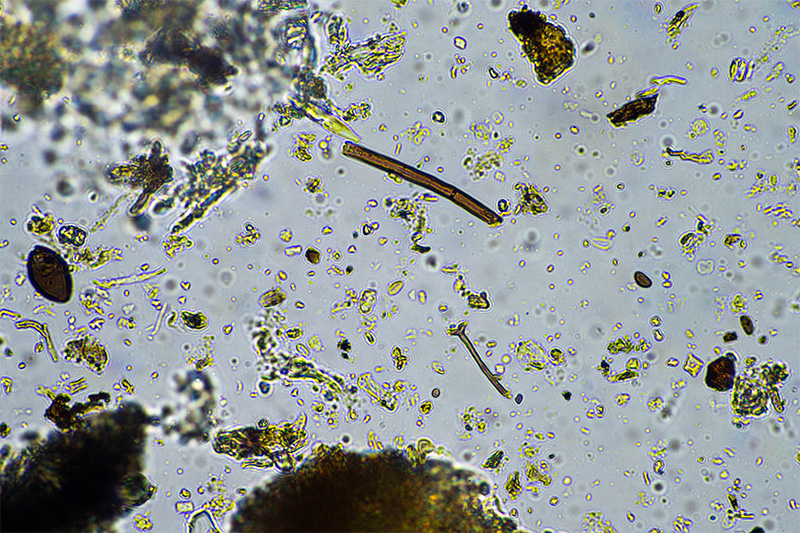
Environmental contamination of water, soil, other environmental media, and consequently of living organisms, continues because of improper disposal and widespread use of novel contaminants, like 1,4-dioxane and per- and polyfluoroalkyl substances (PFAS).
Several techniques can be used to remediate (treat or remove) a wide range of contaminants. For novel compounds that have been identified as harmful to the environment and to humans, physical and chemical strategies are often the primary means of remediating contaminated materials. However, when those are not sufficient, biological methods for remediation—also referred to as bioremediation—can sometimes provide an effective means to address contamination.1 While chemical methods exploit chemical characteristics of the contaminants, such as their ability to be oxidized, and physical methods exploit contaminants’ physical properties, like their ability to evaporate, biological methods exploit the systems and enzymes (biological molecules that act as catalysts or speed up reactions) in organisms to remove or destroy contaminants.
What is Bioremediation?
Bioremediation is a set of biological methods (or techniques) that use living organisms to treat environmental contamination. Bioremediation was first discovered in the 1960’s when George M. Robinson identified bacteria capable of consuming petroleum components.2 These technologies have developed further since that time, to address different environments (aerobic and anaerobic ones, for example),3 as well as contaminants previously thought of as not biodegradable (such as 1,4-dioxane).4
Selected Bioremediation Methods
| Type of Bioremediation | Organism Used | Description |
| Monitored Natural Attenuation | Native Microbes | Monitoring contaminant concentrations over time as native microbes carry out degradation (in situ) |
| Biostimulation | Native Microbes | Stimulating native microbes to carry out degradation more quickly by adding oxygen, nutrients, or electron donors (in situ) |
| Bioaugmentation | Non-Native Microbes | Amending the contaminated area with non-native microbes known to degrade the contaminant of interest (in situ) |
| Phytoremediation | Plants | Cultivating plants on contaminated soils to evaporate, degrade, or promote bacterial degradation of contaminants (in situ) |
| Biopiles | Native Microbes | Extracting soil from a contaminated site and placing it in a pile on an impermeable liner where conditions can be better monitored and adjusted (ex situ) |
| Bioreactors | Native or Non-Native Microbes | Contaminated media is pumped into a bioreactor where microbes (native or non-native) are maintained at optimal growth conditions and can quickly degrade contaminants (ex situ) |
Bioremediation’s use of living organisms can include those as large as trees or as small as bacteria and fungi. Trees, for example, can create an ideal environment in the soil or in groundwater that is in and around their roots where contaminants (like BTEX—benzene, toluene, ethylbenzene, and xylene—volatile organic compounds found in petroleum products)5 can interact with bacteria and fungi to break them down. Trees can also uptake contaminants from the soil or groundwater through their roots and into their leaves, where contaminants (like selenium)6 can evaporate, or into other parts of the tree where contaminants can be trapped (as with arsenic)7 or broken down (as with TNT).8 Bacteria have perhaps been the most widely implemented mode of bioremediation for groundwater contaminants that are more difficult to break down.
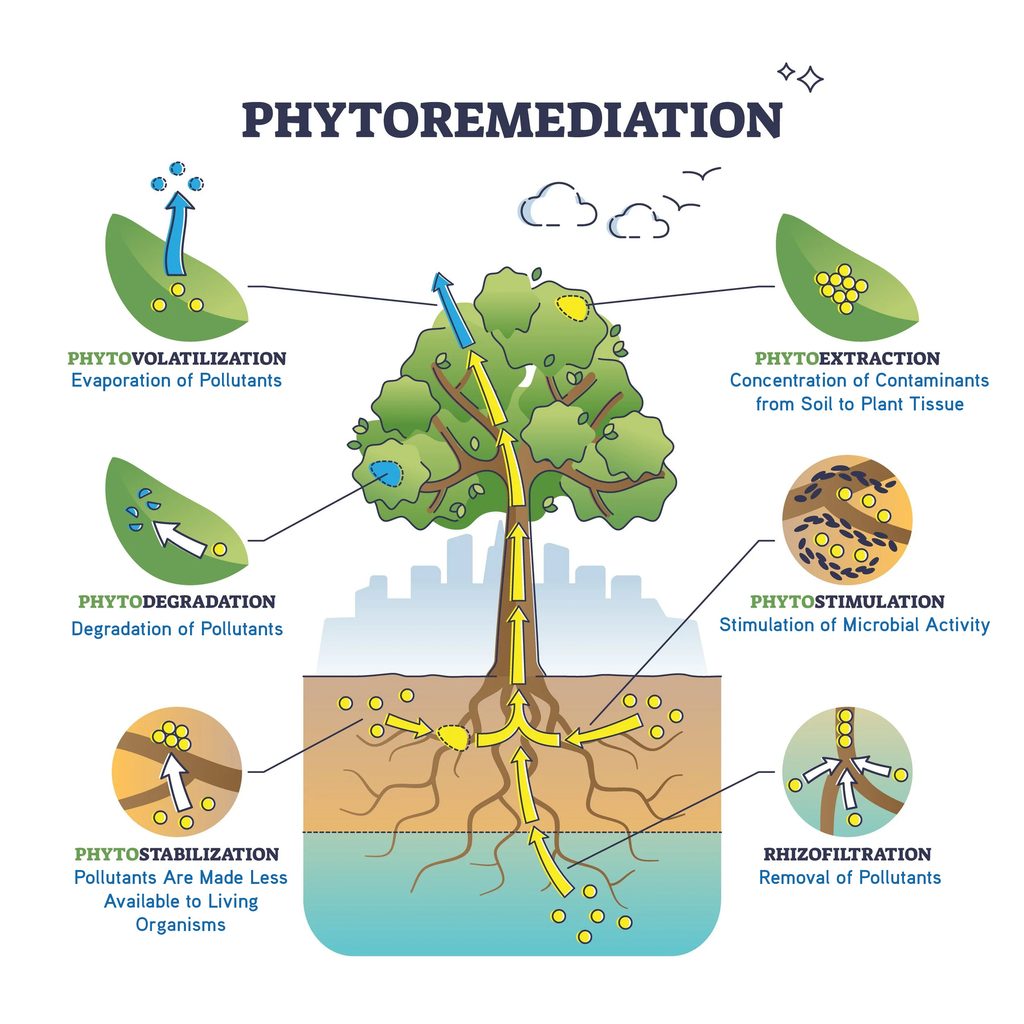
SOURCE: “Phytoremediation,” British Hemp Alliance, accessed September 11, 2026.
Implementation
Environmental remediation generally requires site-specific plans, and the broader applicability of each type of remediation method varies. Classic physical and chemical methods are generally well accepted for appropriate types of sites and contaminants. Bioremediation, however, is highly dependent on the organisms used and the environment in which they are used, in addition to the target contaminant. This has meant that there has been a higher burden of proof for those trying to use bioremediation to prove that the method proposed would work for a particular site.
As bioremediation techniques have advanced, however, greater certainty about their applicability has been achieved, and verification that they will work has been easier to demonstrate.9, 10
Relevant Regulatory Guidance
Federally, the Environmental Protection Agency (EPA) has cited bioremediation methods as environmentally friendly techniques and included them under its Green Remediation Best Management Practices.11 Under the Resource Conservation and Recovery Act (RCRA) as well as under the Comprehensive Environmental Response, Compensation, and Liability Act (CERCLA, commonly known as Superfund), the EPA includes as a best practice the use of in situ (onsite) bioremediation methods, like biostimulation (adding nutrients or adjusting conditions, stimulating native microbes) and bioaugmentation (introducing non-native microbes known to degrade particular contaminants).12, 13 In New York State, the Department of Environmental Conservation (DEC) also includes the use of bioremediation under state codes, rules, and regulations,14 and technical guidance as an acceptable method for dealing with contamination.15
ABOUT THE AUTHOR(S)
Jose Antunes is a New York State science policy fellow at the Rockefeller Institute of Government.
- Saroj Bala, et al., “Recent Strategies for Bioremediation of Emerging Pollutants: A Review for a Green and Sustainable Environment,” Toxics 10, no. 8 (2019): 484. ↩︎
- “Bioremediation,” Encyclopedia.com, updated May 23, 2018. ↩︎
- David L. Freedman and James M. Gossett, “Biological Reductive Dechlorination of Tetrachloroethylene and Trichloroethylene to Ethylene under Methanogenic Conditions,” Applied and Environmental Microbiology 55, no. 5 (September 1, 1989). ↩︎
- John F. Horst, et al., “Bioremediation of 1,4-Dioxane : Successful Demonstration of In Situ and Ex Situ Approaches,” Groundwater Monitoring & Remediation 39, no. 4 (Fall 2019) : 15–24. ↩︎
- Tanja Barac, et al., “Field Note : Hydraulic Containment of a BTEX Plume Using Poplar Trees,” International Journal of Phytoremediation 11, no. 5 (2009). ↩︎
- E.A. H. Pilon-Smits, et al., “Selenium Volatilization and Accumulation by Twenty Aquatic Plant Species,” Journal of Environmental Quality 28, no. 3 (1999) : 1011–8. ↩︎
- Cong Tu, Lena Q. Ma, and Bhaskar Bondada, “Arsenic Accumulation in the Hyperaccumulator Chinese Brake and Its Utilization Potential for Phytoremediation,” Journal of Environmental Quality 31, no. 5 (2002) : 1671–5. ↩︎
- Murali Subramanian, David J. Oliver, and Jacqueline V. Shanks, “TNT Phytotransformation Pathway Characteristics in Arabidopsis : Role of Aromatic Hydroxylamines,” Biotechnology Progress 22, no. 1 (2006) : 208–16. ↩︎
- Jose Manuel Diaz Antunes, et al., “Cluster-Specific Biomarkers for Effective Assessment of 1,4-Dioxane Biodegradation Potentials for Natural Attenuation and Propane Biosparaging,” Environmental Science & Technology Letters 12, no. 12 (2025). ↩︎
- Mengyan Li, et al., “Bench-scale biodegradation tests to assess natural attenuation potential of 1,4-dioxane at three sites in California,” Biodegradation 26 (2015): 39–50. ↩︎
- “Green Remediation Best Management Practices: Bioremediation,” EPA 542-F-21-028, Office of Land and Emergency Management, US Environmental Protection Agency, December 2021. ↩︎
- RCRA Orientation Manual 2014: Resource Conservation and Recovery Act (Washington, DC: US Environmental Protection Agency, 2014). ↩︎
- Handbook on In Situ Treatment of Hazardous Waste-Contaminated Soils (Washington, DC: US Environmental Protection Agency, January 1990). ↩︎
- 6 NYCRR Part 35: Environmental Remediation Program, Effective December 31, 2025 (Albany, NY: New York State Department of Environmental Conservation, 2025). ↩︎
- “Errata Sheet for DER-10, Technical Guidance for Site Investigation and Remediation,” New York State Department of Environmental Conservation, May 3, 2010. ↩︎