On January 3, 2026, US military forces removed Venezuelan President Nicolás Maduro from power and charged him with drug trafficking crimes. The event brought renewed attention to the humanitarian crisis in Venezuela and the plight of displaced Venezuelans in the US and across the globe.
On this episode of Policy Outsider, Institute on Immigrant Integration Research and Policy Deputy Director & Intergovernmental Liaison Guillermo Martinez interviews two Venezuelan not-for-profit leaders about the crisis in Venezuela, how they support Venezuelans from their positions in the US and the UK, and their hopes for the country and its people.
Guests
- Jesús Aguais, Founder, Aid for AIDS
- Alejandro Arenas Pinto, Trustee, Healing Venezuela
- Guillermo Martinez, Deputy Director & Intergovernmental Liaison, Institute on Immigrant Integration Research and Policy
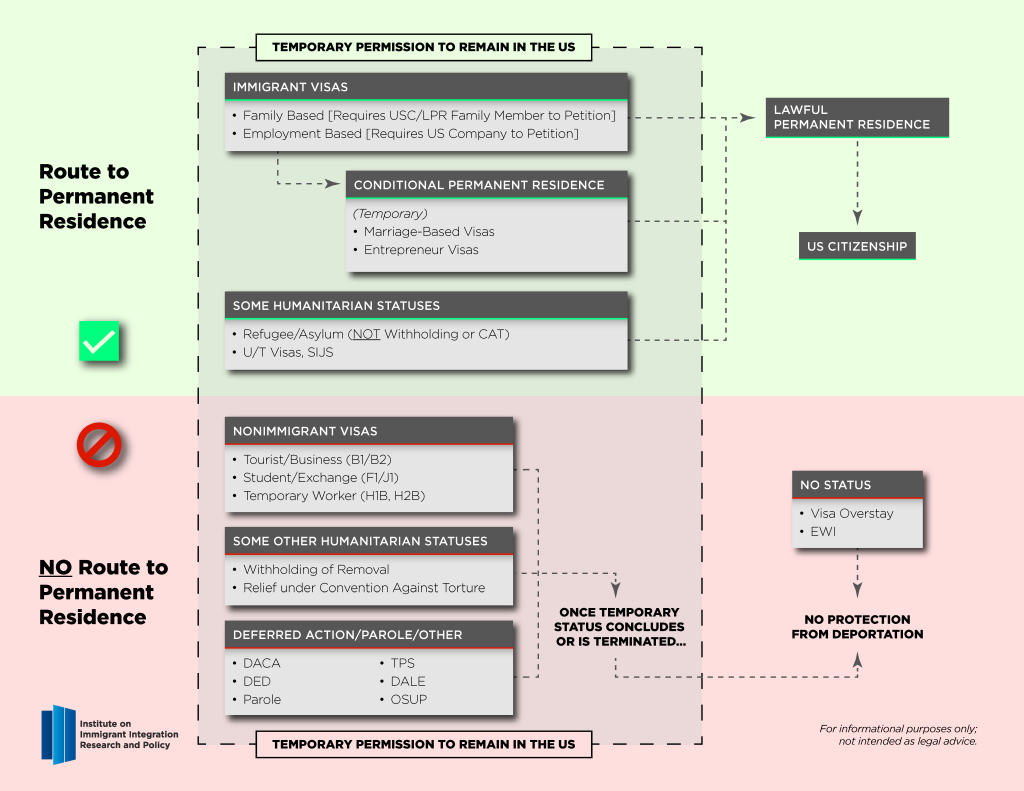
This fact sheet from the Institute on Immigrant Integration Research and Policy provides a quick reference to some more common immigration statuses. This fact sheet is for informational purposes only; it is not intended as legal advice. Special thanks to Lauren DesRosiers, assistant professor of law and director of the Immigration Law Clinic at Albany Law School, and Sarah Rogerson, distinguished professor of law and director of The Edward P. Swyer Justice Center at Albany Law School. Compiled August 2025.
US Citizenship & Nationality
US citizenship is acquired through birth (anyone born in US state or territory, or, if born abroad, may be inherited through US citizen parents under some circumstances) or adoption (under some circumstances).
US citizenship may be acquired through naturalization. [LPR is prerequisite to naturalization.]
Individuals born in any US state or territory acquire US citizenship at birth, EXCEPT American Samoa. Birth in American Samoa does not confer US citizenship, only US nationality.
Lawful Permanent Residence (“Green Card,” “Adjustment of Status”)
Eligibility to apply for Lawful Permanent Residency generally requires prior or simultaneous acquisition of an immigrant visa, qualifying relationship (such as marriage), or other separately acquired status (such as asylum) that renders them eligible to “adjust status.” Individuals in visa/status categories that are not eligible for LPR may be able transition to another status they are eligible for that does provide path to LPR.
- Immigrant Visas [Eligible for LPR]
- Employment-Based Visas: US employers may petition for some foreign workers.
- Family-Based Visas: USCs/LPRs may petition for some close family members.
- Some Humanitarian Statuses [Some Eligible for LPR]
- Refugee status/Asylum: Eligible to apply for LPR 1 year after admission.
- U/T Visa: May be eligible to apply for LPR during limited window after visa grant.
- SIJ: Eligible to apply for LPR when visa available per DOS Visa Bulletin.
- Conditional Permanent Residence (Limited PR)
- Green cards through marriage & entrepreneurship receive 2-year “Conditional Permanent Residence” (CPR). Must apply to remove conditions to receive full LPR.
- VAWA provides alternative routes for individuals with family-based petitions who are abused by the petitioning family member. This allows the applicant to proceed with pursuing immigration status without needing the assistance of abusive US petitioner.
Non-Immigrant Visas [Not Eligible for LPR]
- Tourist/Business Visa (B1/B2): Short term temporary visas for brief visits.
- Student/Exchange Visa (F1/J1): Temporary visas with strict limits on activities and work.
- Temporary Work Visa (H1-B, H2-B): Temporary work visas, limited term and/or seasonal. (High risk of exploitation of vulnerable workers.)
Humanitarian Relief [Some Eligible for LPR]
- Refugee Status/Asylum: Refugee process is administered by UNHCR outside of the United States; applicants for asylum apply within the US; both must meet the definition of “refugee” under UN Convention. Can apply for LPR 1 year after admission to US as refugee (on entry to US) or asylee (on grant of asylum).
- Withholding of Removal/CAT (Convention Against Torture): Similar to asylum, withholding and CAT relief may be available to people who don’t meet all the elements of asylum. They do NOT provide avenue to LPR.
- U/T Visas: Individuals who are victims of some serious crimes (U Visa) or labor/sex trafficking (T visa) and cooperate with law enforcement may be eligible to apply for U/T “nonimmigrant” visa. Despite being termed “nonimmigrant,” some recipients of U/T visas may apply for LPR.
- SIJS (Special Immigrant Juvenile Status): Unaccompanied children who have been abused, abandoned, or neglected by one or both parents may be able to apply for SIJ; when a visa becomes available, they may apply LPR.
- SIV (Special Immigrant Visa): Available to some individuals who assisted US efforts in Iraq & Afghanistan.
Prosecutorial Discretion/Deferred Action/Nonenforcement [Not Eligible for LPR]
- DACA (Deferred Action for Childhood Arrivals): Permits some people brought to the US as children to obtain work authorization and deferral of removal.
- TPS (Temporary Protected Status): Short-term permission for individuals from designated countries experiencing severe violence/war to register for limited protection from removal and work authorization.
- DED (Deferred Enforcement Departure): Defers deportation of individuals from some countries. (Similar to TPS.)
- DALE (Deferred Action for Labor Enforcement): Individuals assisting labor & employment agencies with ongoing investigations into labor violations can be eligible to register for limited protection from deportation and work authorization.
- Parole: Permitted to enter and remain in United States for set period of time. May be eligible for work authorization and other benefits through various parole programs
- OSUP (Order of Supervision): Under some circumstances, individuals that ICE has not removed within 90 days of final order of removal may be released from ICE detention under an Order of Supervision.
No Status [Not Eligible for LPR]
- Visa Overstay: Entered US through port of entry but overstayed permitted time.
- Entry Without Inspection (EWI): Entered between ports of entry and have not subsequently been apprehended or acquired other status.
In some circumstances, pending applications for some immigration benefits/relief may prevent removal during the pendency of the application and may prevent accrual of unlawful presence under the INA.
On this episode of Policy Outsider, Institute on Immigrant Integration Research and Policy Deputy Director & Intergovernmental Liaison Guillermo Martinez leads a conversation with leaders in the Providence Farm Collective, a non-profit organization in Western New York with a mission of cultivating farmer-led and community-rooted agriculture and food systems to actualize the rights of under-resourced peoples.
Guests
- Kristin Heltman-Weiss, Executive Director, Providence Farm Collective
- Hamadi Ali, Deputy Director, Providence Farm Collective
- Guillermo Martinez, Deputy Director & Intergovernmental Liaison, Institute on Immigrant Integration Research and Policy
Learn More
The Elder Economic Security Index is a tool that quantifies how much income older Americans need to meet their basic needs and age in place with dignity. On this episode of Policy Outsider, we unpack how the index works, what the latest findings tell us about economic security in later life, and how policymakers, advocates, and communities can use the index to shape better policy and programs.
Guests
- Maria Alvarez, Executive Director, NY Statewide Senior Action Council
- Nidya Velasco Roldán, Post-Doctoral Fellow, Gerontology Institute, UMass Boston
- Dina Refki, Executive Director, Institute on Immigrant Integration Research and Policy
Learn More
On this episode of Policy Outsider, the Institute on Immigrant Integration Research and Policy is joined by John Ravitz, executive vice president and COO of the Business Council of Westchester and a former New York State legislator, to discuss one of the most pressing issues facing both local and national economies: the workforce crisis. From labor shortages in healthcare and education to the vital role of Westchester’s immigrant workforce, Ravitz offers a candid and informed look at the challenges businesses face and the innovative strategies being used to adapt. The discussion, led by Institute on Immigrant Integration Deputy Director & Intergovernmental Liaison Guillermo Martinez, explores the impact of sweeping immigration policy changes, new federal laws, and the rise of minority-owned businesses, while also looking ahead to how technology and demographic shifts will shape the future of work in Westchester County.
Guests
- Guillermo Martinez, Deputy Director & Intergovernmental Liaison, Institute on Immigrant Integration Research and Policy
- John Ravitz, Executive Vice President and COO, Business Council of Westchester
The delivery industry boomed during the COVID-19 pandemic. In New York City, the engine of this expansion was app-based delivery workers, many of whom are immigrants. On this episode of Policy Outsider, Institute on Immigrant Integration Research and Policy Deputy Director & Intergovernmental Liaison Guillermo Martinez interviews Rockefeller Institute Director of Labor Policy Maria Figueroa about her research into the efforts of these workers to secure improved working conditions and compensation.
Guests
- Guillermo Martinez, Deputy Director & Intergovernmental Liaison, Institute on Immigrant Integration Research and Policy
- Maria Figueroa, Director of Labor Policy, Rockefeller Institute of Government
Learn More
- View Maria’s presentation at the Institute on Immigrant Integration’s 2025 annual conference, “Engineering Cohesive Communities: Social Integration of Foreign-Born Americans.”