
The intersection of firearm violence and maternal health can be devastating.
Eighteen-year-old Kaylin Fiengo was pregnant when, in 2025, her boyfriend lured her to a park and shot her while she sat in her car. Fiengo died in the shooting, and the pregnancy was lost.
Pregnancy is widely understood as a time when health and safety should be particularly protected. Yet, in the United States, violence is the second leading cause of death during pregnancy and the postpartum period (< 42 days after delivery), exceeded only by drug overdoses. These death rates from violence exceed those of any other medical condition experienced during pregnancy. From 2018 through 2023, one study found that out of 7,901 total deaths among pregnant and postpartum birthing individuals, 866 were due to violence—a rate of 3.9 deaths per 100,000 live births. More than two-thirds (68 percent) of the deaths from violence were homicides, and 32 percent were suicides. Firearms accounted for most homicides (77 percent) and 39 percent of suicides. By comparison, cardiovascular disease, the next leading cause of death, had a lower rate of 3.4 deaths per 100,000 live births.
Pregnancy certainly does not cause violence. It can, however, intensify existing vulnerabilities and be a period of heightened risk for intimate partner violence (IPV). Changing relationship dynamics, financial dependence, reproductive coercion, and attempts to leave an abusive relationship may increase danger. At the same time, focusing only on individual relationships misses the broader context. Racial segregation, neighborhood disinvestment, economic insecurity, uneven access to confidential support, and differences in firearm and reproductive health policy all shape who is exposed to violence and who can reach safety.
In our 2025 study, we analyzed homicides of women using the Centers for Disease Control and Prevention’s (CDC) National Violent Death Reporting System (NVDRS) data from 2018 to 2021. Because NVDRS records sex rather than gender identity, we use the term “women” to reflect the classification available in the database. We identified 7,063 homicides among women aged 15 to 49 years old. We defined pregnancy-associated homicides as homicides of women who were known to be pregnant or within the first year postpartum as classified by the NVDRS (hereafter referred to collectively as “pregnant women”). Across the 37 states with data for this analysis, there were 434 pregnancy-associated homicides—more than one every four days. The highest proportion of pregnancy-associated homicides occurred among women 20 to 24 years old (32.5 percent), compared to women 25 to 29 years old (22.6 percent), the next highest age group.
Across the 37 states with data for this analysis, there were 434 pregnancy-associated homicides—more than one every four days.
Pregnant women experienced a 26 percent higher overall homicide rate than nonpregnant peers (49 versus 39 deaths per 1 million live births), driven largely by firearms. The firearm homicide rate was 37 percent higher among pregnant women compared to nonpregnant women (39 versus 28 deaths per 1 million). Across the 2018–21 study period, firearms were used in nearly four out of five pregnancy-associated homicides. Although pregnant women were at higher risk for both overall and firearm-specific homicide than nonpregnant peers, the burden was not distributed equally. Non-Hispanic Black women accounted for the greatest proportion (57.6 percent) of pregnancy-associated homicides, followed by non-Hispanic White women (24.4 percent) and Hispanic women (10.6 percent). Women with a high school education or less accounted for 72.3 percent of these homicides. These patterns reflect risks shaped not only by pregnancy, but also by longstanding racial, economic, and geographic inequities.
Firearms Drive Pregnancy-Associated Homicide
As noted above, firearms accounted for most pregnancy-associated homicides, with handguns being the most identified firearm. More than one-third (34.3 percent) of pregnant women who were killed with a firearm died at home, followed by 23.5 percent in an emergency department or outpatient setting. Although place of death alone cannot establish the circumstances of a homicide, this pattern appears consistent with prior research showing that intimate partner violence (i.e., domestic violence) is involved in most pregnancy-associated homicides. Firearm access can increase the likelihood that abuse or conflict becomes fatal. The firearm is not incidental; it is often what makes the violence lethal.
Where You Live Matters
Pregnancy-associated firearm homicide rates varied dramatically across states, indicating that where someone lives influences the risk of death. Louisiana had the highest pregnancy-associated firearm homicide rate at 111 deaths per 1 million live births, while New Hampshire, Rhode Island, and Vermont had none recorded for our study period (2018–21). Among the 33 states with at least one pregnancy-associated homicide, firearms accounted for at least 75 percent of pregnancy-associated homicides in 21 states. The wide variation across states also raises a fundamental question: why does the risk of being killed during pregnancy depend so heavily on where someone lives?
Firearm-Specific Pregnancy-Associated Homicide Rates per 1,000,000 Live Births by State, 2018–21
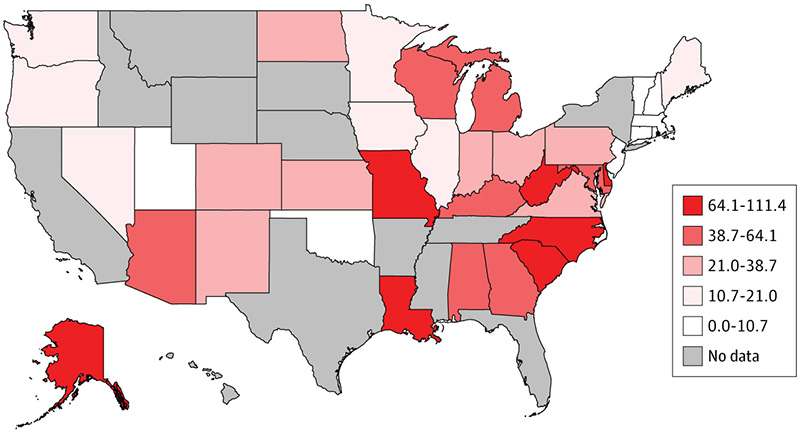
SOURCE: Figure from Ayesha Dholakia, et al., “Firearm Homicide in Pregnant Women and State-Level Firearm Ownership,” JAMA Network Open 8, no. 11(2025):e2542447.
To examine one potential explanation for this state-level variation, we tested the association between the estimated state-level firearm ownership and pregnancy-associated homicide. Every one-percentage-point increase in firearm ownership in a state was associated with a six percent increase in the state’s overall pregnancy-associated homicide rate and an 8 percent increase in the state’s firearm-specific pregnancy-associated homicide rate, even after accounting for differences across study years and state characteristics, such as poverty, unemployment, and population density. These findings suggest that even relatively small increases in firearm prevalence may translate into appreciable increases in the risk of firearm homicide among pregnant individuals.
Estimated Firearm Ownership Prevalence by State*
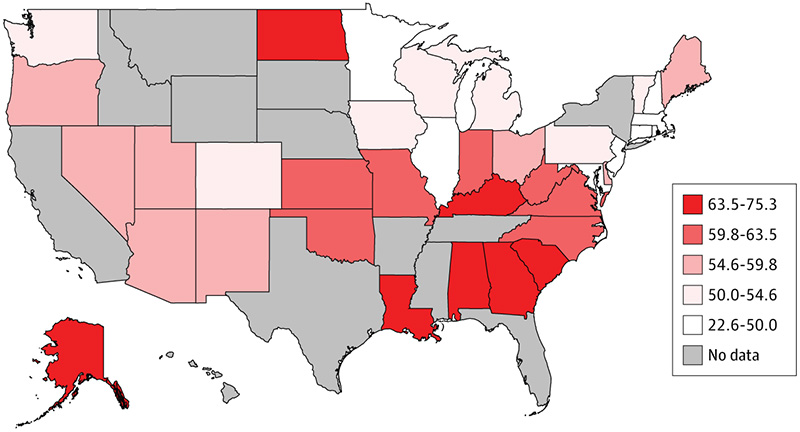
* Rate calculated as ratio of firearm suicides to total suicides by state (more on this here)
SOURCE: Figure from Ayesha Dholakia, et al., “Firearm Homicide in Pregnant Women and State-Level Firearm Ownership,” JAMA Network Open 8, no. 11(2025):e2542447.
Firearm availability is not the only state-level factor that may matter. Research has also linked more restrictive abortion policies with higher rates of intimate partner violence. Because IPV is a major risk factor for pregnancy-associated homicide, differences in reproductive policy by state may likewise compound the effects of firearm availability and contribute to the wide geographic variation in risk.
Limitations and Data Gaps
These findings likely do not capture the full burden of firearm violence during pregnancy. Only since 2018 have all 50 states been able to include pregnancy on death records, allowing records to indicate that the decedent was pregnant or had been pregnant within the prior year at the time of death. Even then, pregnancy status may be missing or misclassified. In our study, we were only able to include data from 37 states. We excluded 13 states, including highly populated states such as California, Florida, and Texas, because the NVDRS captured less than 85 percent of the homicides among women reported in the CDC’s Web-based Injury Statistics and Query Reporting System (WISQARS). Incomplete capture may reflect challenges in obtaining and linking records from medical examiner or coroner reports and law enforcement systems, particularly in states with decentralized reporting systems. Further, national data on nonfatal firearm injuries during pregnancy range from limited to nonexistent. When deaths and injuries are not counted, the true burden of violence during pregnancy remains unknown. Improving data surveillance and linkage across reporting systems, alongside more complete documentation of pregnancy status, is therefore essential to understanding and preventing these deaths.
- Reducing firearm access among people at risk of violence. We can support evidence-based state-level policies, including universal background checks, waiting periods, minimum age requirements for purchase, domestic violence firearm prohibitions paired with mandatory relinquishment, and extreme risk protection orders that allow courts to temporarily remove firearms from people at risk of harming themselves or others.
- Integrating violence prevention as part of maternal healthcare. Prenatal, postpartum, and pediatric visits all provide opportunities to identify IPV and discuss firearm access. Screening should be paired with confidential referral processes, safety planning, legal advocacy, and connections to resources.
- Expanding or ensuring reproductive healthcare access. Because restrictive abortion laws are associated with higher rates of IPV, comprehensive reproductive healthcare should be treated as part of broader violence prevention strategies.
- Investing in social and economic supports. Safe housing, financial resources, educational opportunities during and after pregnancy, and sustained community investment can help pregnant individuals reach safety and reduce exposure to violence.
- Improving data and accountability. States should consistently record pregnancy status, include homicides in maternal mortality reviews, and build surveillance systems capable of capturing both fatal and non-fatal firearm injuries during pregnancy.
Options for Policymakers and Health Systems
We can help prevent firearm homicides in pregnancy through public policy, but no single intervention is sufficient. The evidence points to several complementary strategies:
Firearm homicides in pregnancy can be prevented. In a country capable of delivering extraordinary obstetric care, pregnancy need not be a period of heightened vulnerability to deadly violence. Better protections for pregnant people, however, require understanding and treating firearm policy, intimate partner violence prevention, reproductive care, and economic security as maternal health interventions. It also requires addressing the existing sociodemographic and geographic disparities that put certain individuals at higher risk of death. Maternal safety depends not only on the care available inside hospitals, but also on the systems that determine whether pregnant people are safe in their homes and communities.
ABOUT THE AUTHOR(S)
Lois K. Lee is a member of the Regional Gun Violence Research Consortium at the Rockefeller Institute of Government. She is a Professor of Clinical Pediatrics in the Department of Pediatrics at Harvard Medical School and a pediatric emergency medicine physician at Boston Children’s Hospital.
Ayesha Dholakia is a member of the Regional Gun Violence Research Consortium at the Rockefeller Institute of Government. She is a pediatric emergency medicine fellow at Boston Children’s Hospital.