
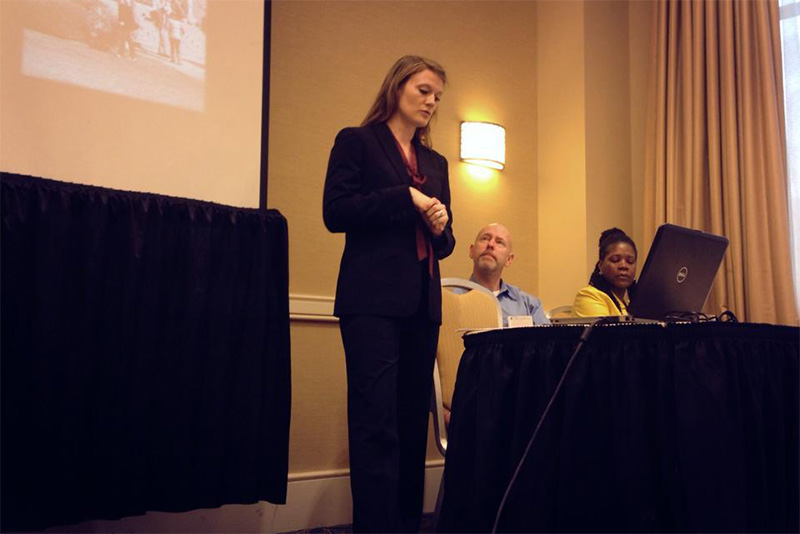
Experts with the Regional Gun Violence Research Consortium (RGVRC) address different facets of firearm violence from a variety of perspectives and disciplines. In this new series, get to know our experts and learn more about their contributions to better understand, prevent, and respond to the public health crisis of firearm violence. Get to know H. Jaymi Elsass, an affiliate scholar with the RGVRC and Associate Professor of Instruction in the School of Criminal Justice & Criminology at Texas State University.
Why do you study gun violence? Why is this an important area of research, and how do you see your work helping to address this issue?
I began studying mass public shootings in graduate school, particularly through the lens of moral panic, which led to investigations into the nexus of these attacks with public policy and media coverage. What makes this field particularly important is that it operates in a space where ideology often substitutes for evidence. Rigorous, transparent, peer-reviewed research gives policymakers something concrete to act on beyond reactive legislation, helps distinguish interventions that feel effective from those that actually are effective, builds cross-partisan support by focusing on outcomes rather than political positions, and creates accountability so that bad policies can be identified and revised. The goal is to decrease the prevalence of these events, as well as their lethality when they do occur. Further, when prevention fails, it is important to know what determines how lethal an attack becomes for the creation of tactics for both first responders and civilians alike.
There is credible evidence that mass shootings have a social contagion component—that high-profile attacks inspire subsequent ones, particularly when perpetrators seek notoriety. My work in this area focuses on quantifying the contagion effect and its duration, testing whether responsible reporting guidelines—particularly around withholding perpetrator names and images—are associated with measurable reductions in subsequent attacks, and the role of online radicalization communities (certain forums, manifestos) in accelerating the pathway to violence.
What is your research focus related to gun violence? What are you currently researching?
My work sits at the intersection of criminology, mass media, and policy analysis, with a specific concentration on mass public shootings rather than gun violence broadly. That distinction matters—the drivers, dynamics, and intervention points for mass shootings differ meaningfully from those for other types of gun violence, though there is important overlap. Currently, I am working with other scholars to build the most comprehensive database of United States mass public shootings to date. It will be housed with and disseminated through the Regional Gun Violence Research Center at the Rockefeller Institute of Government. The hope is that public access to this resource will foster methodologically sound research that will more widely inform public policy regarding mass public shootings as well as gun violence more generally.
What do you hope that people can take away from the research you are conducting?
My work is grounded in a simple premise: mass public shootings are by and large not random, unpredictable acts of nature. These events are not inevitable. That’s the most important thing. There is a cultural fatalism around mass shootings in America right now—a sense that they are as unpredictable and unstoppable as lightning strikes, that nothing can be done, that we simply have to absorb them as a cost of modern life. The research directly challenges that. Mass public shootings are human behaviors that follow patterns, have identifiable precursors, and occur within systems that can be made more or less responsive. That means they are, at least partially, preventable—and that’s what makes this research worth doing.
Learn more about Jaymi and her work for the Regional Gun Violence Research Consortium below.